Stand With Ukraine

Sunday, March 9, 2025

Physics problem: acceleration of water level in a container due to draining from an opening in its bottom

Problem statement

From an opening at the bottom of a tall container, water drains out. The cross-section area of the container is $S$, and the cross-section area of the draining stream of water is $\sigma$. The water level in the vessel moves downward with constant acceleration. Determine this acceleration.

Solution

I'll describe two methods to solve the problem: the first one is the one I used and it is based on Bernoulli's law (energy conservation) and the second one is using the Toricelli's formula and accompanying assumptions from the get go. The second one I would guess a more experimented physicist would use and be done with it (see the approach 2). If I were to think about the second approach right away, this post would not happen.

Approach 1

Let's denote the speed of the water at the surface of the container and at the draining hole as $v_0$ and $v_1$ respectively. Then we can write energy and mass conservation expressions for the two cross-sections as follows:

\begin{align*} \begin{cases} \frac{v_0^2}{2} + gh = \frac{v_1^2}{2} \\ v_1\sigma = v_0 S \end{cases} \end{align*}

where $h$ is the current water level in the container, ang $g$ is the acceleration due to gravity.

Now, if we eliminate $v_1$ from the energy conservation equation and apply a time derivative to the both sides of the equation we will obtain the following relation (we use an upper dot to denote a time derivative, $\dot{x}=\frac{dx}{dt}$):

\begin{equation*} 2 v_0 \dot{v_0} + 2g\dot{h}=\left(\frac{S}{\sigma}\right)^2 2 v_0 \dot{v_0} \end{equation*}

Let's denote the acceleration of the water level as $a=\dot{v_0}$, and also note that $v_0 = -\dot{h}$ (the minus sign here is added because the level $h$ is decreasing with time and I prefer to consider $v_0$ as speed value without direction). Using this notation, the previous equation can be written as:

\begin{equation*} 2 v_0 a - 2gv_0=\left(\frac{S}{\sigma}\right)^2 2 v_0 a \end{equation*}

Simplifying we get the following expression for the water level acceleration in the container:

\begin{equation*} a = \frac{g}{1 - \left(\frac{S}{\sigma}\right)^2} \end{equation*}

Now we could consider that the conditions given in the problem statement imply $S\gg\sigma \rightarrow S/\sigma \gg 1$, therefore we can approximate the above expression as:

\begin{equation*} a \approx -g\left(\frac{\sigma}{S}\right)^2 \end{equation*}

Note that $a = \dot{v_0} < 0$, meaning that the water level descent in the container is slowing down with time.

Approach 2

For this approach we recognize right away that the problem conditions allow the use of Toricelli's formula for the speed $v_1$ of draining water from a large container with the water level at $h$:

\begin{equation*} v_1=\sqrt{2gh} \end{equation*}

The draining water will cause the change to the water level as follows: \begin{align*} \dot{h}=-v_1\sigma/S=-\frac{\sigma}{S}\sqrt{2gh} \end{align*}

If we apply a time derivative to the above equation and substitute $\dot{h}$, we obtain:

\begin{align*} \ddot{h} & =-\frac{\sigma}{S}\sqrt{2g}\frac{1}{2\sqrt{h}}\dot{h} \\ & = g\left(\frac{\sigma}{S}\right)^2 \end{align*}

Since the water level acceleration is $a = \dot{v_0} = d_t \left( -\dot{h} \right) = -\ddot{h}$, we obtain the final expression using the above relation for the second derivative of the water level as:

\begin{align*} a = -g\left(\frac{\sigma}{S}\right)^2 \end{align*}

Note that in this case we did not have to make any approximations as they were already applied for the Toricelli's formula to be valid (mainly that the speed of the water level $v_0$ is much lower than the draining speed $v_1$).

Sunday, December 29, 2024

Physics problem: cumulative shell colliding with an armoured wall

Introduction and problem statement

This problem, as many others appearing here, took me a lot of time to wrap my head around. I almost lost faith, even tried to ask ChatGPT to solve it for me few times, but ChatGPT's solution was wrong or completely obscure for me.

Here is the problem statement (translated by ChatGPT from the Savchenko et al 1981 book).

Problem statement: In 1941, the Germans invented a cumulative anti-tank shell. The shell has a fuse on its front part, which, upon impact, causes detonation and ignites the entire charge. The shell penetrates the armor. In 1944, such German shells came into the hands of both the Soviets and their allies. Extensive experiments began. Various additional effects and paradoxes were discovered. The researchers started to investigate what exactly was penetrating the armor. At first, they thought it was a jet of hot gas that burns through the armor. However, it turned out that a metal jet is piercing through the armor traveling in a very puzzling way: in front of the plate at a speed of $v_{0} = {\rm 8\;km/s}$, inside the plate at ${\rm 4\;km/s}$, and behind the armor plate again at ${\rm 8\;km/s}$.

Explain this phenomenon and determine the speed of the metal wall of the conical cavity covering the charge, given that the cone’s vertex angle is 30°.

I have to admit that the translation is pretty accurate.

  • You might prefer to read the notebook version of the post here.
  • Latex sources for the plots are available here.
No description has been provided for this image
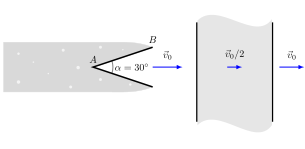
Figure 1: Cross-section of cumulative shell heading towards the armoured wall.

Solution

The problem consists of two parts. The first one asks to explain the phenomenon and the second one asks to determine the speed of the collapsing conical wall that is separating the fuse and the explosive charge of the shell, this collapsing wall is forming the metal jet piercing through the armor. I'll proceed in the order I solved it initially, starting with the part 2.

Part 2

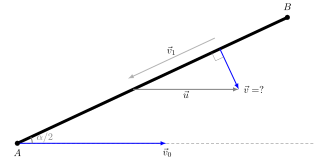
Let's determine the speed of the conical wall collapsing into the jet flowing onto the armor at a speed of $v_{0} = {\rm 8\;km/s}$ as shown in Fig. 2. We focus here only on the upper part of the conical wall cross-section ($AB$, see Fig. 1 as well).

The breaking moment for me here was to realize that the velocity of the conical wall is orthogonal to its surface ($\vec{v}$ in Fig. 2). Since it is collapsing under the pressure force of the gas/liquid created to the left of the cone surface after the explosion of the charge.

No description has been provided for this image
Figure 2: Cross-section of the upper part of the collapsing conical wall.

Let's consider a reference frame in which the cone material flows along the cone surface at speed $\vec{v}_1$. This reference frame is moving to the right at a horizontal speed $\vec{u}$, so that the following relation is satisfied:

\begin{equation} \vec{v} - \vec{u} = \vec{v}_1 \end{equation}

In this reference frame the horizontal part of the jet is moving at speed $\left|\vec{v}_1\right| = v_1$ (here and below we ommit the arrow to denote scalar variables). This is relatively easy to prove using energy conservation. In summary we have the following system of equations:

\begin{align} \begin{cases} \vec{v} - \vec{u} = \vec{v}_1\\ v_0 - u = v_1\\ \end{cases} \end{align}

From the triangle formed by the speed vectors in Fig. 2 we get: \begin{align} \begin{cases} v_1 = v / \tan\left(\frac{\alpha}{2}\right)\\ u = v / \sin\left(\frac{\alpha}{2}\right) \end{cases} \end{align}

Now using the last two equations and the relation $v_0 - u = v_1$ we get an equation with respect to $v$:

\begin{align*} v_0 - u = v_1 & \Rightarrow v_0 - v / \sin\left(\frac{\alpha}{2}\right) = v / \tan\left(\frac{\alpha}{2}\right) \\ &\\ & \Rightarrow \boxed{v = \frac{v_0 \sin\left(\alpha/2\right)}{1 + \cos\left(\alpha/2\right)}}\\ &\\ & \Rightarrow v\approx 1.05\:{\rm km/s} \end{align*}

Part 1

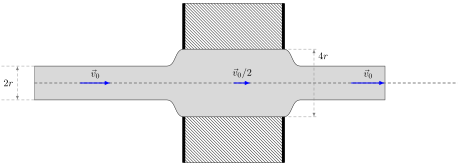
The first part of the problem is to explain the phenomenon, mainly why the speed decreases by a factor of two in the armor. It is more or less clear that the jet will slow down due to the friction with the armor and then will accelerate back behind the armoured wall to the initial speed as it is being pushed forward. The factor of two for the velocity can be explained by the size of the hole pierced by the jet in the armoured wall (as shown in Fig. 3) which is two times larger than the diameter of the jet.

No description has been provided for this image
Figure 3: Metallic jet formed from the collapsed conic wall after piercing through the armoured wall, after the stationary flow regime is established.

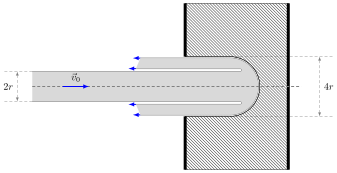
So now we need to explain why the hole would be approximately twice the size of the metal jet piercing through the armor. For this we need to consider the moments before the hole is pierced completely. At this point there is a part of the jet that flows backwards reflected from the armor as shown in Fig.4 below, which expands the hole. The symmetry and mass conservation would hint us towards the factor of two for the hole diameter.

There is however a question, why would the backflow velocity be directed exactly in the opposite direction with respect to the incident jet. Indeed, this is not obvious.

No description has been provided for this image
Figure 4: Metallic jet formed from the collapsed conic wall prior to piercing through the armoured wall.

To find the angle at which the backward flow is reflected we can consider two colliding jets of liquid: smaller with a radius $r$ and a larger one with a radius $R$, moving towards each other at equal and parallel speeds (we can always switch to the reference frame where the metallic jet and the armoured wall move at equal speeds towards each other). As a result of the collision of the jets, a conical backflow in the direction of the smaller jet is formed. If we denote the angle of the cone as $2\beta$, then using momentum, mass and energy conseration it is relatively easy to show that the angle of the cone can be computed using dimensions of the colliding jets as follows: \begin{equation} \cos\beta = \frac{R^2-r^2}{R^2 + r^2} \end{equation}

Now, for our problem if we take the radius of the metallic jet to be $r$, it is much smaller than the effective radius of the armoured wall:

\begin{align} r \ll R & \Rightarrow \cos\beta = \frac{R^2-r^2}{R^2 + r^2} \approx 1 \\ & \Rightarrow \beta \approx 0 \end{align}

which means that indeed in our case the backflow is directed antiparallel to the incident jet velocity.