
The following problem, as many others, is coming from my usual source of inspiration, i.e. from Savchenko et al (1981) book. I am currently working through the section on surface tension phenomena. I decided to share this problem here mostly because of the beautiful answer, which is independent of surface tension coefficient of the liquid and of the stick's size, the result is just a number. Another reason for this post is that the problem is completely removed from newer editions of the book.
I did not pay much attention to the plot in the problem statement which is supposed to be used to get information necessary for the solution. I only realized that after Google AI turned my attention to the profile of the surface of the liquid prior to touching long sides of the stick.
Here is the translation of the problem statement:
A very long and thin stick with a square cross-section floats on the surface of a liquid, as shown in the figure. How much higher is the stick's density than the liquid's density (expressed as a ratio)?
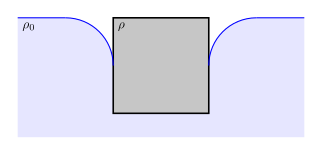
We denote the length of the stick as $l$ and the side of its rectangular cross-section as $a$.
Let's consider forces acting on the stick along the vertical axis. Surface tension, buoyancy force and gravity, respectively, will compensate each other as follows:
\begin{align*} 2\sigma (l+a) + \rho_0 l a^2 g - \rho l a^2 g = 0 \end{align*}
where $\sigma$ is the surface tension coefficient, $\rho$ and $\rho_0$ are densities of the stick and of the liquid respectively.
The stick being very long and thin, means $l \gg a$ and we get the above equation simplified to:
\begin{align} 2\sigma + \rho_0 a^2 g - \rho a^2 g = 0 \end{align}
Now we consider the part of the liquid surface between the point where it touches the stick and the undisturbed horizontal plane. Let's denote this part of the liquid surface as $AB$ (see the figure). Now we approximate the form of $AB$ as a segment of a circle of radius $r$ (we will later take it to be $r=a/2$ as can be seen from the figure in the problem statement).
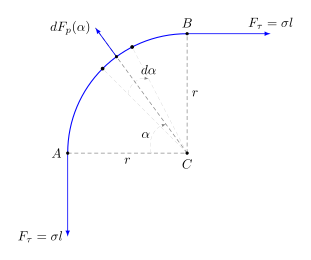
Let's consider horizontal forces acting on $AB$: $F_{px}$ - pressure force pushing the liquid towards the stick and $F_{\tau}$ surface tension preventing the liquid from touching the stick.
\begin{align*} F_x = F_{\tau} - F_{px} = 0 \end{align*}
$F_{\tau} = \sigma l$ - is the surface tension force applied at point $B$.
$F_p$ - is the total pressure force acting along the $AB$ parallel to the radius at each given point of $AB$. Its horizontal component is the following integral:
\begin{align*} F_{px} & = \int\limits_{0}^{\pi/2} dF_p(\alpha) \cos\alpha \\ & = \int\limits_{0}^{\pi/2} \rho_0 g l r(1-\sin\alpha) \cos\alpha \cdot r d \alpha = \\ & = \int\limits_{0}^{1} \rho_0 g l r^{2}(1-z) d z = \\ & = \frac{1}{2} \rho_0 g l r^{2} \end{align*}
Now the force balance equation gives us:
\begin{align*} & \sigma l - \frac{1}{2} \rho_0 g l r^{2} = 0 & \Rightarrow \\ & \sigma = \frac{\rho_0 g r^2}{2} & \end{align*}
Now, since $r = a/2$, we get
\begin{align*} \sigma = \frac{\rho_0 g a^2}{8} \end{align*}
Now we can use this expression for $\sigma$ in the equation obtained from the balance of the forces acting on the stick.
\begin{align*} & 2\sigma + \rho_0 a^2 g - \rho a^2 g = 0 & \Rightarrow \\ & \frac{\rho_0 g a^2}{4} + \rho_0 a^2 g - \rho a^2 g = 0 & \Rightarrow \\ & \frac{5}{4} \rho_0 - \rho = 0 & \Rightarrow \\ & \boxed{\frac{\rho}{\rho_0} = \frac{5}{4}} & \end{align*}
Finally the density of the stick is 1.25 times higher than the density of the liquid, and it still floats.

No comments:
Post a Comment